
Globalization Cannot Be Turned Off

Words and ideas have the potential to steer the direction of the world. Spoken by few but very powerful people, words can gain enough force to impact the lives of everyone. They become reality, like gravity, wind, or water: a powerful and unavoidable force of nature to which every person on Earth is subject.
At the turn of the century, United States President Bill Clinton expressed his thoughts about globalization at the Vietnam National University, as it welcomed the country into the global economy.
“Globalization is not something we can hold off or turn off. It is the economic equivalent of a force of nature, like wind or water. We can harness wind to fill a sail. We can use water to generate energy. We can work hard to protect people and property from storms and floods. But there is no point in denying the existence of wind or water, or trying to make them go away. The same is true for globalization. We can work to maximize its benefits and minimize its risks, but we cannot ignore it, and it is not going away.”
— Bill Clinton, Hanoi, 2000
In November 1989, the fall of the Berlin Wall signified the beginning of a new period. It opened the door to new, more liberal things to come, not only for East Germans but for the parts of the world that had been ideologically on the eastern side of the Iron Curtain during the Cold War.
The wave of globalization that began after the collapse of the USSR and the spread of liberal market democracy across Europe and the rest of the world made a dent in history at a global scale. The establishment of the World Trade Organization in 1995 represents a pivotal moment for world trade. During that year alone, 36 economies joined the WTO. Today, the organization has 166 members.
World Trade Index
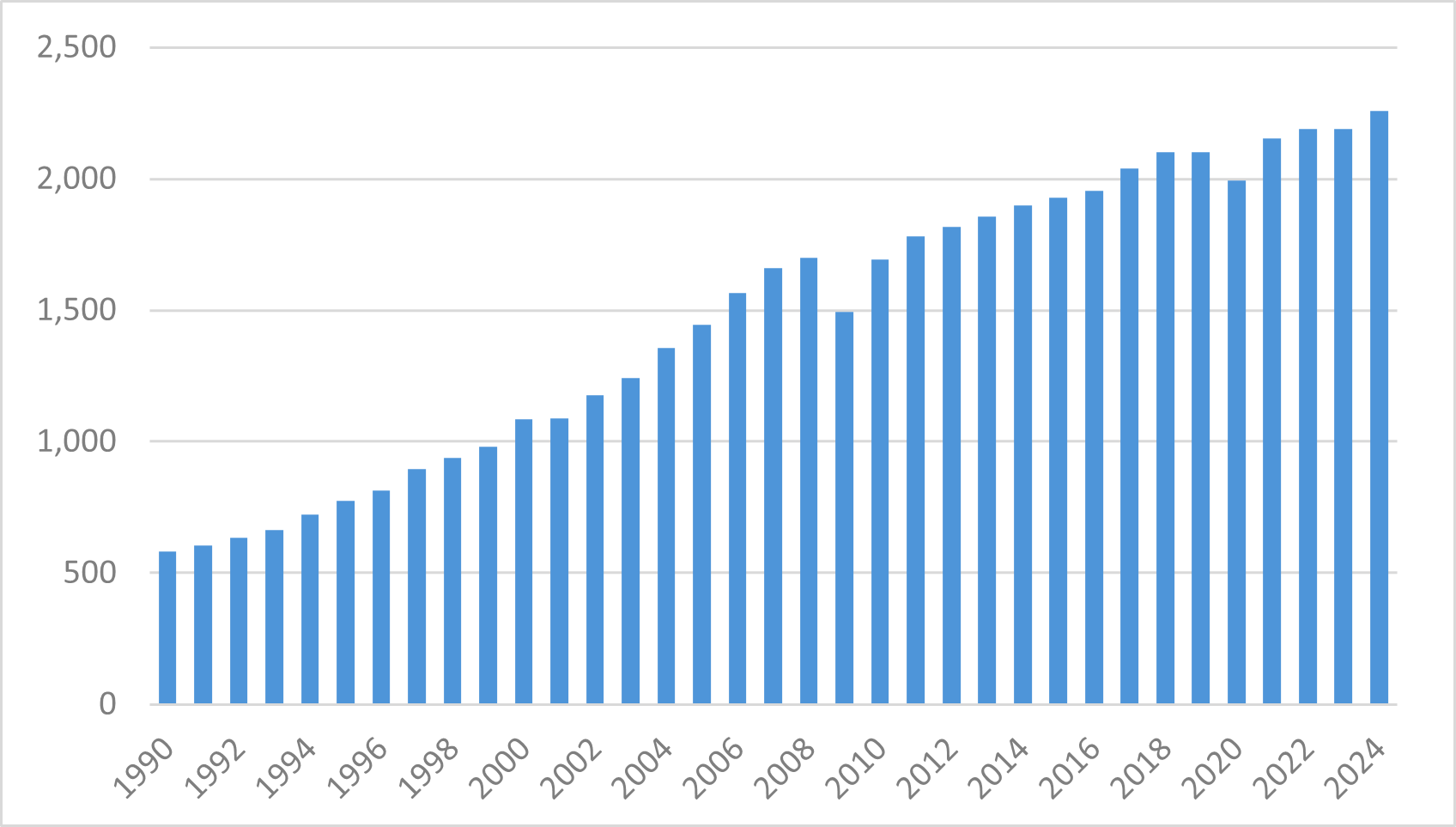
Note: Based on the average of exports and imports values, adjusted for inflation (1800 = 1).
Source: Our World in Data
In Washington, the promotion of commerce and economic relationships between countries was supported by the idea that political liberalization would follow. If countries freely traded goods, their societies would eventually seek greater political participation, and democracy would emerge. This idea brought China into the international arena, welcoming the country into the WTO in 2001 and releasing the potential of 1.27 billion people hungry for economic growth and capable of creating it.
These developments led to the reconfiguration of national economic structures and international economic balances. The US share of world manufacturing in the 1980s was around 30%; by 2023, this figure had fallen to 16%. Asia absorbed much of the world’s manufacturing: its share rose from 18% in 1980 to 35.9% by 2000, and to more than half of the world’s manufacturing output by 2025. China’s share of world manufacturing in the 1980s was just 4%. Today, that number has risen to 29%, making it the largest manufacturing powerhouse in the world.
Manufacturing, Value Added (Millions of US$)
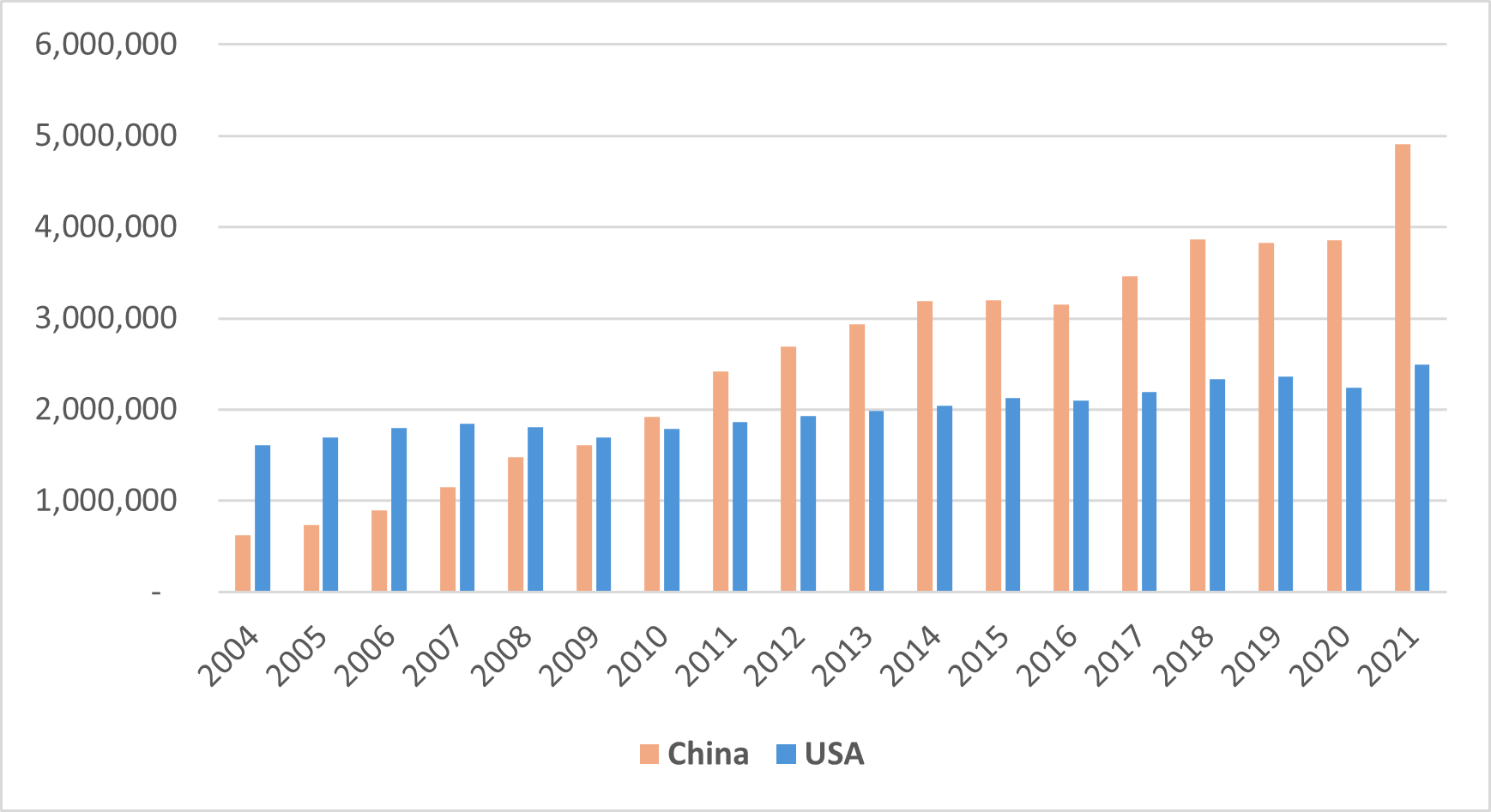
Source: World Bank
President Clinton also said in Hanoi in 2000:
“The movement of people, money, and ideas across borders, frankly, breeds suspicion among many good people in every country. They are worried about globalization because of its unsettling and unpredictable consequences.”
- A Note on Ideology
Ideology takes societies to places they have not been before. Values, beliefs, and ideas shape people’s interests and decisions. Ideology defines the interests of groups, social classes, and states. It provides an explanation of reality, making sense of the conditions people face and shaping a common consciousness. It offers a guiding structure through which individuals develop their identity and, accordingly, actionable answers to questions about politics, economics, and social matters. The ideas people hold function as lenses through which they see the world and act within it.
Source: Introduction to The Power of Ideology: From the Roman Empire to Al-Qaeda
By Alex Roberto Hybel
Shift in Mindset
Although developing nations in Asia and other regions of the world performed well economically over the last 30 years, globalization also placed pressure on middle-class households in industrial economies. Many saw their incomes stagnate and their living conditions deteriorate.
Over time, the conditions in which people lived brought about a shift in mindset. With a natural inclination toward improving their lives, priorities changed, followed by decisions. Ideas that were initially regarded as beneficial became obsolete when their effects failed to positively impact the lives of the majority. New political figures emerged and undertook drastic reconfigurations in an attempt to improve their economies.
The global order set forward after the fall of the USSR was neoliberal in nature, promoted by the largest and strongest players in the international arena, whose ideas were not meant to be questioned. Unforeseeable consequences lay on the horizon, impossible to imagine within the short - to medium - term interests of the Western liberal world of the 1990s: the rise of others.
This brief dispatch sheds light on the ever-changing tides of time. It points to shifts in the collective imagination, in the feelings and priorities of people, leaders, and entire countries. It is written to reflect on the consequences of actions taken by both the few and powerful, as well as the vast and weak. The information and figures presented are only a brief illustration of the effects of human decisions, visible only after decades.
Dots can only be connected when looking backward. Once the rules of a new period are set and agents are released to interact, unintended consequences reveal themselves only with time.
When considering the consequences of decisions being made today by political leaders, only time will tell. The most constructive response is to understand the reality of the present moment. Only by acknowledging a period of change the right questions can be asked, and better decisions be made moving forward.